Arturo Benedetti Michelangeli (1920-1995)
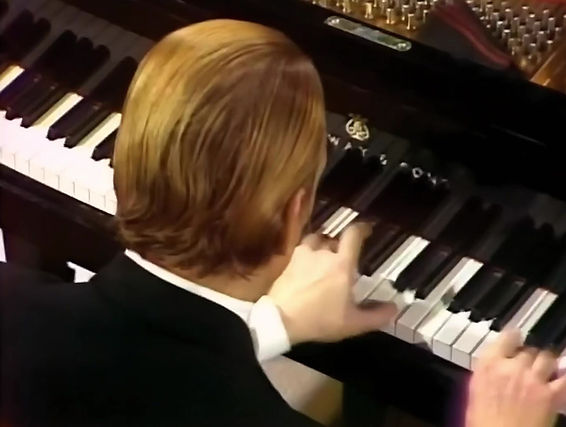
1972-74
You can see ABM's red/brown hair clearly here, before he dyed it jet-black (Toronto 1970)
1972
In early May 1972, AMB had been scheduled to give concerts in Hamburg, Munich and Frankfurt. He played the first two but cancelled the third. In Frankfurt, he was evidently dissatisfied with the quality of pianos offered him. As reported in the Frankfurter Allgemeine Zeitung , he said "I don't feel like it' when asked to account for the cancellation. His blunt language made no friends. The FAZ pubished an Opinion piece on 15 May, signed HL and headed "Irritating". On the 20th Carlos Kleiber came to the defence of his colleague. His arguments are similar to those he used in 1966 to justify his withdrawal from Berg's Wozzeck at the Edinburgh Festival. In essence, an artist has to be true to him/herself.
Charles Barber, Corresponding with Carlos : a biography of Carlos Kleiber
5 May 1972: Konzerthaus, Vienna: Galuppi, Sonata No. 5, Schumann, CArnaval, Brahms Ballades Op.10 and Paganini Variations. [ARMELLA p.431]
Michelangeli did not appear again in the USA after 1972, according to the Baltimore Sun, 23 April 1995.
September 19, 1972: Croisière Paquet “Renaissance”, Mediterranean Sea (Radio Broadcast | FLAC)
· Mozart: Piano Quartet No.2 in E-flat major, K.493
– Jean-Pierre Wallez, violin / Claude-Henry Joubert, viola / Frank Dariel, cello / Arturo Benedetti Michelangeli, piano
– Aura 2000-2. This was recorded aboard a cruise ship.
Sunday 15 October, 1972: Stadthalle am Johannisberg, Wuppertal-Elberfeld, Germany including Brahms Op.10 and Schumann's Carnaval. Konzertdirektion: Rudolf Wylach (Wuppertal).
'The next concert programme with the Stuttgart Orchestra in the autumn of 1972 was of a completely different nature, predominantly virtuosic and effective: Weber's Euryanthe Overture, Grieg's Piano Concerto with Arturo Benedetti Michelangeli, Richard Strauss's Death and Transfiguration, and Ottorino Respighi's I pini di Roma. The success must have been incredible, judging by the Stuttgart press reports. "What a job this Celibidache has done!" Wolfram Schwinger enthused at the time in the Stuttgarter Zeitung.
With this programme, they subsequently went on tour through the Federal Republic. I heard the Munich concert on 27 November, 1972, and could only confirm the impressions already recorded elsewhere. The concert was a triumph for Benedetti Michelangeli, the orchestra, and of course for Celibidache himself. He was also quite satisfied with the result of the evening, as I learned from him in the artists' room. Incidentally, it was an exceedingly long concert, so that in view of the late hour, Celibidache waived the encores he usually willingly gave.
Klaus Weiler, Celibidache - Musiker und Philosoph (2008)
24 December 1972: Il Piccolo di Trieste announces a musical Caribbean cruise in the Tropics with Bach, Vivaldi and Benedetti Michelangeli.
He is the one who will go with Pro Arte on the "Tropical Musical Cruise." And with the Munich orchestra, Benedetti Michelangelì will play. «The greatest pianist of all time, whom Italians let slip by taking his whims of a childlike genius too seriously.»
«Il massimo pianista di tutti ì tempì che gl’italiani. sì sono lasciati scappare per aver preso troppo sul serio le sue bizze di genio sempre bambino».
How two characters, two vital and existential temperaments, two antiithic aesthetic attitudes like Redel and Benedetti Michelangeli can find a single point of agreement
we will know after the cruise at the end of January. The oceanic
musical feerie will depart from Nice and, touching the Canary Islands, will
tour the major islands of the Caribbean. A twenty-one-day cruise for forty concerts, musical chats at the table over drinks, cocktails, and breakfasts for lunch. Participants included, in addition to musicians and musicians, some five hundred music lovers from all over Europe and America with bankable assets that we can only imagine.
1973
Concerts with Carlos Kleiber in Hamburg. New tour in Japan.
The New Yorker, 4 November 1972 had carried an advert, noting that ABM would be one of the artists on board (was he or wasn't he?!): The Sixth Music Festival at Sea aboard the Renaissance in the Caribbean, January 4-17, 1973. The Renaissance sails from Port Everglades, Florida. 'Write for colorful brochure or see your travel agent.'
In an interview with Dominic Gill in June 1973, AMB was asked if he was nervous before a concert. 'Everything depends upon the preparation. A recital is made by what has gone before, not by what happens while it is being played. (...) You've got to have the stage in your blood. Of course one is nervous in a sense, but I've been through a war and I know what being afarid means, because death is the same for everybody. (...) One must be built, or build oneself, in such a way as to be a victor always.' [I'm not sure this reference to war is a proper answer!]
On Saturday 6 January 1973, Corriere della Sera asked:
What are the hands of Arturo Benedetti Michelangeli suffering from? An insurmountable barrier has been erected to protect the privacy of the celebrated pianist since yesterday in Verona. All that is known for certain is that his hands are entrusted to the care of Professor Giovanni De Bastiani, director of the university's orthopedic and trauma clinic.
Yesterday morning, the pianist was seen climbing the stairs of the hospital and reaching the first floor where the orthopaedic department is located. (But i does not seem serious despite the dark silence on the matter)
This medical detail may explain why H.M.V. sessions, originally intended for Piano Concertos by Grieg & Schumann with Michelangeli and Rafael Frühbeck de Burgos in late January 1973 at Abbey Road Studio 1 were transferred to Sir Adrian Boult and Wagner extracts. There exists a spectacular live recording of the Grieg with the same conductor and the New Philharmonia on Thursday 17 June, 1965: Royal Festival Hall, London.
With the Hamburg State Opera Orchestra, Kleiber led performances of Beethoven's Coriolan, R. Strauss' Death and Transfiguration and the Emperor Concerto with ABM (ten years older). It must have seemed like a bizarre pairing. For all that, it was later propose that they record the concerto together; their life performances had gone surprisingly well. In 1975, they gave it a strange try.
Charles Barber, Corresponding with Carlos : a biography of Carlos Kleiber
April 1973
Cord Garben picks up the story: 'It was fortunate that ABM, having closely followed the conductor's career, wanted a concert with Kleiber. Thus, the Hanseatic
audience was presented with a special event, for which music critics and audiences came from far and wide. All three concerts in the same subscription series (April 8, 9, and 11, 1973), to which Kleiber added Beethoven's Coriolanus Overture and Richard Strauss's Death and Transfiguration, were performed with the same group of musicians, including ABM. Critics noted a growing understanding between the two artists with each passing evening: Kleiber's new interpretation of the orchestral part of Beethoven's Fifth Piano Concerto was particularly appreciated.
Through unorthodox bowing and phrasing, he had effectively "lightened" the
string part, making it transparent. It goes without saying that Deutsche Grammophon
didn't want to miss such an event in the Hamburg Musikhalle—that is, right "on their doorstep"—without taking advantage of it. ABM was already contractually tied to the record company, while the recording of Freischütz with Kleiber was imminent. The ideal match had therefore been found, both artistically and commercially.'
London
'When ABM arrived in London in 1973, it transpired that his Steinway had been left out on the docks in Hamburg and that the action had suffered from damp. Twelve replacement, Steinways were tried and deemed inadequate. A substitute concert was arranged for a fortnight later. "He's still got 12 minutes to cancel," cynics reflected in the auditorium.
Daily Telegraph, 13 June 1995
18 March, 1973: Royal Festival Hall, London, England (Audience Recording)
Bach/Busoni: Chaconne from Violin Partita No.2 in D minor, BWV 1004
Schumann: Faschingsschwank aus Wien (Fantasiebilder), Op.26
Brahms: Four Ballades, Op.10
Brahms: Variations on a theme by Paganini, Op.35 [edited by Michelangeli]
*Encore: Chopin: Mazurka in G minor, Op.67 No.2
8, 9, 10 April 1973, Musikhalle am Karl-Muck-Platz, Hamburg
Beethoven, Emperor with Carlos Kleiber
21 May, 1973: Lugano, Switzerland (Radio Broadcast )
Bach/Busoni: Chaconne from Violin Partita No.2 in D minor, BWV 1004
Schumann: Carnaval (Scènes Mignonnes sur Quatre Notes), Op.9
Brahms: Four Ballades, Op.10
Brahms: Variations on a theme by Paganini, Op.35 [edited by Michelangeli]
This can be heard on CD: Aura 978-3-86562-779-7
Beethoven, Concerto No. 4 in G major, Op.58?
'In the big mess of ABM's discography there are few certainties, but everything we know leads to rejecting the attribution of [a recording of Beethoven's Concerto No. 4 in G major Op.58] to him. We know that the performance (issued on CD by Exclusive and Legend) was taped in Belgrade on 7 October 1973 and the conductor was Zivojin Zdravkovic. Now, during that period ABM was not present in Belgrade (his wife is on record on this). The only time ABM played in Yugoslavia was in 1971. There are no other ABM recordings of the Beethoven IV, and there is no evidence that he ever performed the concerto in public. However, there is evidence that Maria Tipo - incidentally, a wonderful and underrated pianist - played the Beethoven IV on that date in the capital of the former Yugoslavia. Having said that, it is a terrific performance regardless of who was the actual pianist.' (Paulo Pesenti)
'Also on the programme was Debussy La Mer and Sofoson 1 by the Serbian composer,
Branislava Šaper Predić. The original broadcast, in fine sound, is identical to this wishywashy bootleg. The confusion was brought about by a famous pirate LP label wishing to obfuscate the issue and make some money out of it.'
("Noël", Slipped Disc blog, January 2020; confirmed by the Belgrade Philharmonic archive)
Jornal do Brasil (16 April 1973): 'The Italian Cultural Institute in Rio de Janeiro informs that the Escola Musical da Vila Schifanoia, in Fiésole, near the city of Firenze/Florence and one of the most picturesque corners of Italy, has opened enrollment for its 1973-1974 academic year of training courses for young pianists. These courses, lasting three years, are directed by Arturo Benedetti Michelangeli in collaboration with Professor Orazio Frugoni, director of that school, which in recent years has achieved great international renown. Registration precedence is established.'
Japan
A Steinway was transported from Hamburg to Tokyo. A recording exists of Beethoven's Sonata n. 4 in E flat major, Op. 7 with ABM playing in the NHK Hall , Tokyo on 20 October, 1973. He also played Galuppi and Schumann's Carnaval.
23 October, 1973: Dai Ichi Hall, Kyoto - cancelled: Beethoven Op.26, Schubert ,Sonata in A minor D537, Brahms's 4 Ballades, and the Paganini Variations
[Daiichi = ?Rohm Theatre Kyoto, officially known as Kyoto Kaikan]
25 Festival Hall, Osaka - cancelled
29 October, 1973: Bunkakaikan, Tokyo, Japan
· Schumann: Faschingsschwank aus Wien (Fantasiebilder), Op.26
· Chopin: Piano Sonata No.2 in B-flat minor, Op.35
· Ravel: Valses nobles et sentimentales
· Ravel: Gaspard de la Nuit
2 November, NHK Hall, Tokyo [programme as Kyoto on 23rd]
(Personal note: I bought my copy of a 2CD set of the 29 October recital in Tower Records, Shibuya, Tokyo in April 2014)
Antonio Armella records that a recital on 15 October in Tokyo's Bunka Kaikan was cancelled as was a programme on 25 October in Festival Hall, Osaka.
Japanese Wikipedia has this (unsourced): 'His first visit to Japan in 1965 shocked (presumably in a pleasant way) the Japanese music world. He has visited Japan several times since, but only this first visit performed as scheduled. His subsequent cancellations have been met with turmoil. During his second visit in 1973, he changed concert dates and venues due to poor conditions, and some performances were canceled. He returned the following year in 1974 to make up for the previous year's performances.
CD liner notes (from the Japanese)
'In the autumn of 1973, Michelangeli was scheduled to perform six concerts, including those in Kyoto and Osaka, with three different programmes, starting with a recital at the Tokyo Bunka Kaikan on October 15th and ending with a recital at the NHK Hall on November 21st. The invitation was from the Japan Cultural Foundation, with support from the Asahi Shimbun Company, Asahi Broadcasting Corporation, FM Tokyo, and FM Osaka.
I had planned to broadcast the first of these concerts on the 19th as part of the "TDK Original Concert" programme, which was then produced by FM Tokyo.
'Michelangeli was rumoured to have been a nervous and difficult-to-please pianist, and was known for his habit of canceling concerts at the last minute, a reputation known as the "cancellation scientist." (1965, Yomiuri Shimbun). When the company first invited him, his manager, the late Takayanagi Masuo, apparently used this to his advantage to promote him, selling tons of tickets while saying, "He won't play (even if he comes to Japan). He won't play!" (Takayanagi would continue to brag about this for years to come.)
As expected, the opening recital in 1973 was canceled at the last minute. This meant I had to abandon my plan to broadcast it before NHK (NHK supposedly aired the 20th October recital at NHK Hall on their FM program on the 26th).
'In the end, we were able to record the recital hosted by the Tokyo Metropolitan Theatre on October 29th. The programme was the same A-programme as the 20th. The broadcast date was delayed until December 21st, but it was only natural that everyone was grateful that it could be broadcast at all. However, on the day of the broadcast, the manager himself was obviously on edge, even to an outsider. He was standing in front of the stage, facing the one-point stereo set up.
'Michelangeli's [the manager's?] face turned pale when he saw the hanging microphone, and he asked that it be removed, because he didn't know what the Master would say if he saw something like that (meaning that he might get angry and call off the concert, saying it was an eyesore). He also harshly warned me that during practice, the master would alternate between playing the piano on stage and one in the wings, and that none of the staff should ever come face to face with the master during those sessions.
'Fortunately, Michelangeli didn't say anything when he saw the microphone set up at the front of the stage. He continued to play the two pianos, silently going back and forth frequently between the stage and wings. It didn't seem like he had any particular intention of using his favorite piano. He must have had his own unique way of thinking. We, the staff, were also enjoying the game of hide-and-seek, laughing like bad boys running away from the scary teacher.
'It was some time after the rehearsal that I panicked for a moment. For some reason, he also looked taken aback. Naturally, my manager hadn't introduced me to the maestro, so I belatedly exchanged a few greetings. Michelangeli then asked, somewhat hesitantly, "Are you the radio man? I've already finished the rehearsal, but is the mic test enough?" It turned out he was fully aware of the situation and was being considerate in his own way. Naturally, he wasn't averse to being recorded or anything.
'Even so, Michelangeli's performance that day was captivating beyond words (...)
The atmosphere was so intense it was almost overwhelming, and I felt as if I had been given a glimpse of the demonic sensations hidden behind this maestro's intelligent control, which left me speechless.'
(Music critic, former producer at FM Tokyo)
On 9 December, 1973, 'Maestro Benedetti Michelangeli gave a recital at the Salle Pleyel in Paris, entitled "Mémoire du Martyre du Juif Inconnu."'
1974
April 5, 1974: Teatro Apollo, Lugano, Switzerland (Radio Broadcast | AAC256)
· Haydn: Piano Concerto No.4 in G major, Hob.XVIII:4
· Mozart: Piano Concerto No.15 in B-flat major, K.450
– Edmond de Stoutz / Züricher Kammerorchester
Victoria Hall, Geneva, Switzerland
'In short, what we witnessed on Sunday evening was a piano recital with orchestra, as the audience had clearly come to hear Arturo Benedetti Michelangeli! The programme was perfectly suited to this, as it included no less than two concertos. In this regard, the soloist cannot be praised enough for choosing two little-known pieces: Joseph Haydn's beautiful Concerto in G major, whose concertante work for keyboard is hardly ever performed in public, and W.-A. Mozart's admirable K. V. 450 in B flat major, rarely performed in concert halls. ... The great Italian once again proved himself to be an outstanding performer. What refinement in his limpid playing, with its marvellous evenness of touch! But also what taste in the design of the lines, never gratuitously virtuosic, always expressive! And finally, what musicality in the shaping of a phrase, carried through to its full meaning with exemplary sobriety! Despite all the reserve with which the pianist surrounded himself, he was the object of endless ovations from an audience which, beyond its apparent coldness, was able to recognise his profound, authentic sensitivity. Mr Edmond de Stoutz, who, at the head of the Zurich Chamber Orchestra, was a valuable collaborator for the soloist, gave a very fine performance of Mozart's famous Symphony in G minor at the beginning of the evening.'
Courrier de Genève, 9 April 1974
Sunday, 19 May 1974, Municipal House – Smetana Hall, Prague
Ludwig van Beethoven: Egmont. Overture op. 84
Edvard Grieg: Concerto in A minor for piano and orchestra, op. 16
Bohuslav Martinů: Symphony No. 6 /Symphonic Fantasies/
Prague Symphony Orchestra – FOK; conductor Ladislav Slovák
The incomparable Benedetti-Michelangeli. The famous Italian pianist performed in Prague again after several years. In Grieg's piano interpretation of the concerto with two masterful encores (Chopin's Mazurkas), he once again confirmed that he belongs to the greatest piano masters of our time. His musical expression ranges from dematerialized pianissimos to highly dramatic peaks, a fantastic perfection in which there is no trace of self-interest, created a completely new experience from this concert, as if cleansed of all usual mannerisms and yet deeply effective in its pure aesthetic beauty. I think it goes without saying that this unique art also had a unique response.
Jaromír KŘIŽ, Večerní Praha 20.5.74
Tel Aviv (October 1974)
The Arthur Rubinstein International Piano Master Competition (Tel Aviv) came into being
in 1973, at the initiative of Jan Jacob Bistritzky, a close friend of Arthur Rubinstein, who was honored to give his name to the Competition. The Competition first took place in
1974 and is held every three years. ABM served on the jury for Septmeber 1974 and 1977. The winners were Emanuel Ax and Gerard Oppitz respectively.
Bistritzky, who emigrated from Poland in 1971, had brought his professional expertise with him. In Warsaw, he had already directed the world-famous Frederyk Chopin Institute and the Chopin Piano Competition.
For 1974, members of the international jury included Arthur Rubinstein, Guido Agosti (Italy) and Jacques Fevrier (France), friend of Poulenc since childhood
11 September 1974, Mann Auditorium, Tel Aviv, Israel: Beethoven's Sonata Op.7 in E flat 'sounded strange because of irrelevant musical gestures and mannerisms which seemed to place the artist's empathy with the music in question. Neither did the intensely emotional second movement, the Adagio which crowns the work, amount to anything spectacular. The third movement, which has the sudden switch to the dark minore seemed to inspire Michelangeli's imagination. He gave a stunning performance of the four Ballades of Brahms. Although it may not have been to everyone's taste, there can be no doubt that only Michelangeli can play them as he did.' The Jerusalem Post (16.9.74)
The Hungarian-langauge Új Kelet (20.9.74) wrote: One of his increasingly rare public appearances, which he did not cancel at the last minute, ... In addition to his excellent piano playing, our artist has become famous for this. He demonstrated his sympathy for our people with the concert dedicated to the "memory of the unknown Jewish martyr" held in the Salle Pleyel in Paris in December of last year. (...) He played Brahms's four ballads Op. 10 so spiritually that we imagined ourselves at a séance conjuring up astral bodies. [S amint oly átszellemülten játszotta Brahms négy balladáját Op.10 hogy asztráltestek szellemidéző szeánszán képzeltük magunkat.] There is something in Michelangeli, an almost ghostly trait abstracted from the world and, at the same time, a tendency to break it down into atoms: Beethoven's E flat major, Op. He analysed the emotional Largo movement of his 7th sonata almost bar by bar, breaking it down into small parts, but in the closing rondo his eternal Italian singing inclination awoke in him and he led through and built up the folk-like themes with delightful ease. As an encore, he played Debussy's youthful ‚Hommage à Ravel“ with unsurpassed elegance, as a silent confession of an esoteric, carefully secluded from the outside world, with an overly refined nervous system, an excellent performer.
LÁSZLÓ PATAKI
'As for the best piano playing of any kind heard in Israel during those eventful weeks, that was provided by the redoubtable Arturo Benedetti Michelangeli of Italy. Prior to joining Rubinstein and Eugene Istomin as a juror for the final stage, Michelangeli offered an “Hommage a Israel” recital in Mann Auditorium, with all the receipts donated to the funding of the Rubinstein competition. It is all too long since Michelangeli (the Italians call him “Benedetti”) has been heard in the United States—1968. But the interval has only added to the mastery that makes him, at 50, the greatest living craftsman at his specialty of casting spells and conjuring up pianistic miracles.
'When he had caressed the keys and solicited the strings’ cooperation in his concepts of Beethoven’s Opus 7 Sonata, the four Ballads (Opus 10) of Brahms, and the B-flat Minor Sonata of Chopin, he responded to a tumult of applause by spinning the measures of Debussy’s “Hommage a Rameau”—which few pianists risk in public—into a weblike filigree of sound both imaginative and impalpable. Challenged to explain why he has neglected America so long, Michelangeli responded that it was too far away, that he could play many more concerts in Europe during a week than in the States. If Italy wants Congress to help out in its financial dilemmas, it had better get “Benedetti” over here, subito
Irving Kolodin, Saturday Review (19 October 1974)
Tuesday/Wednesday 15/ 16 October, 1974: Théâtre des Champs-Élysées, Paris, France (WATCH HERE)
· Beethoven: Piano Concerto No.5 in E-flat major, Op.73 (Emperor)
– Sergiu Celibidache / Orchestre National de l'ORTF
– Also on an Electrecord LP
Antonio Armella gives details of a visit to Japan with 2 recitals.
24 October 1974, Dai Ichi Hall, Kyoto and 3 November, Festival Hall, Osaka.
1973年、アルトゥーロ・ベネデッティ・ミケランジェリは再び来日し、東京・京都・大阪で演奏しました。
このウェブサイトの作者は、2014年4月に渋谷のタワーレコードで、そのリサイタルの一枚のCDを購入できて大変喜びました。
Mazurkas
Chopin was truly an incomparably singular phenomenon of his profession, a Pole (Sarmatian) with a French education, French customs, with the strengths and weaknesses of both tendencies. [Wilhelm von Lenz]
Lacking physical strength, Chopin concentrated entirely on the singable style, on relationships and connections, on detail. He was therefore a pastellist "such as no one had ever been before." (Chopin's Mazurkas are the diary of his soul's journeys into the political and social sphere of the Sarmatian dream world!). His performance was at home there; Chopin's originality as a pianist dwelt there. He represented Poland, his dreamland, in the Paris salon, which in the time of Louis-Philippe, from his point of view, could be considered an influential political power. Chopin was the only political pianist. He offered Poland, he composed Poland.
Benedetti Michelangeli's interpretation seems to come very close to this characterisation. Even in his playing, we hear both the "dreamland" of the Paris salon, pushed to the limits of decadence and languor, and the brutal, combative spirit of revolutionary Poland in the 1830s. At the time, all of Europe was suffering under the influence of "Young Poland": a wave of sympathy united the rest of the world in the fight for freedom, which would soon be replicated in German territories.
ABM manages to interpret the almost infinite range of mazurkas, from the softly feminine to the rustic peasant dance. In just a few bars, as the formal structure dictates, he shifts with great stylistic sensitivity from one extreme to the other,
without ever losing inspiration. [Cord Garben 43f.] However - in the review of a London recital it was noted of the great Mazurka in B minor, Op.33 No.4: 'wonderous inflections, no trace of dance'. (Musical Times, August 1990)
The ever gracious and perceptive english musicologist Joan Chissell reviewed the Chopin LP in Gramophone June 1972, putting on the disc with some trepidation. 'Would he be aloof and calculating? Or might he thaw? The phrasing is so malleable and the playing so responsive to the mood of the moment that I found it hard to believe this really was imperious Michelangeli. You sometimes almost feel that you might be listening to Chopin himself improvising. The B-flat minor scherzo, surprised me more than anything else in the recital. I thought it was so familiar by now that no one could ever hope to hear it with new ears. It is a tonic to hear each mazurka given such potent character without rhythmic idiosyncrasy or (worse still) whimsy. I'm glad he has unearthed an edition of Op.68/4 in F minor with the once missing middle section reinstated. This was Chopin's last composition of all, written in acute awareness of life's transience: you can guess as much from Michelangeli's intimately inflected phrasing.'
In Arturo Benedetti Michelangeli as I Knew Him, Lidia Kozubek claims that ABM saw Chopin's Mazurkas 'more perhaps in the style of Tyrolese dances from his native Alpine climes, but what a wealth of moods and impressions they contain!' Discussing Michelangeli's Chopin album (for DG), Władysław Malinowski (Rocznik Chopinowksi [Chopin Yearbook] Νο. 17, 1985) is said to have found in the Mazurkas that all of Michelangeli's characteristics are to be found to an even greater degree than elsewhere.
"The last Mazurka, in B minor, which closes opus 33 [and one which ABM played many times] is one of Chopin’s great wonders. In it, we hear a synthesis of the heard and remembered with the personally experienced and profoundly true. Lyrical contemplation and dialogue, eruptions of passion, rocking and calming. ‘Where did Chopin hear and catch red-handed the plaintively graceful melodies of kujawiaks, the fiery rhythms of the mazur and the dizzy arabesques of the oberek?’ asked Stefan Kisielewski semi-rhetorically in his beautiful essay on Chopin, written in 1957. ‘How did he transport them out of Poland’, he went on to ask, ‘like that symbolic clod of native soil? How did he preserve them, not eroded, not sullied, on the market of the world – in faraway Paris? It is a mystery, just as the extraordinary unity of his musical personality, made up of so many contradictions, is a mystery. But let us allow Chopin’, concludes Kisielewski, ‘a few mysteries, let us not try to account for everything’."
Mieczysław Tomaszewski