Moriz Rosenthal
Updated: Aug 6

Pianist Charles Rosen (b.1927) recalls…
At age 11 he left Juilliard to study piano with Moriz Rosenthal (1862-1946) and with Rosenthal's wife, Hedwig Kanner. They had settled in New York from Austria in 1938, following the Anschluss, the annexation of Austria by Nazi Germany. (Peter Sühring suggests they left in 1936. “The Rosenthals emigrated to the USA relatively early; many of their Jewish colleagues did not do so until 1938 following the Anschluss.”)
Rosenthal studied with Karol Mikuli (during 1872-74), a pupil of Chopin, and later with Franz Liszt. he first met the composer in October 1876 in Vienna, and he studied with the Master during the period 1876 to 1878 and from 1884 to 1886.
'Before he commenced studies with Liszt, Rosenthal toured Poland and Romania where the fourteen-year-old boy was made court pianist to the Romanian royal family. While studying with Liszt in Rome and Weimar he was sometimes fortunate enough to be the only student, receiving Liszt’s sole attention.' (Jonathan Summers)
Liszt left no significant remarks about Rosenthal‘s playing during the classes 1884-1886. For example after Rosenthal played the Chopin Barcarolle on June 20, 1885 August Göllerich wrote that the Master said Rosenthal took “a fairly fast tempo”. Göllerich wrote nothing after Rosenthal played Liszt, Au bord d'une source. In general, the playing of his pupils provided an occasion for Liszt to make important pronouncements about the art of the piano - an art that he ultimately felt could not be taught.
Though Jorge Bolet was not impressed with his five lessons in Vienna in 1935 with this celebrated pupil of Liszt - and a legendary pianist in his own right-, Charles Rosen has a more favourable impression.
In spite of, his immense reputation for caustic remarks about other pianists ("Now you have the tempo, you can put in the thirds" was his comment on one of [Vladimir]de Pachmann's less successful salon renditions of Chopin's Etude in thirds"), he was a very kind and generous man. In fact, during all that time, he rarely told me that I was wrong about something in the music: "I have a different idea of this piece, he would say gently".
He almost never discussed technique with me, in spite - or perhaps, because - of his formidable reputation as a technician. Josef Hofmann once said that he did not know what piano technique could be until he heard Rosenthal.
Rosenthal went for long walks with Brahms and often spoke about him. About his studies with Liszt, he was more reticent: when I asked him what the lessons were like, he said only that it was difficult to get Liszt out of the café and back to the studio.
(This may be in conflict with another reminiscence of Rosenthal: 'In Tivoli, near Rome. . . I was fortunate to be his only student and to receive daily instruction in the autumn of 1878. Every afternoon I appeared at the Villa d'Este, where I found the master composing either in his study or sometimes on the terrace, where he was gazing forlornly into the blue. The glowing Roman autumn, the picturesque beauty of the area, the Master's noble instruction - all these things blended into an ecstasy which I still feel today.' Editor's note)
On one occasion, when I played the Handel variations of Brahms for him, Rosenthal stopped me in the middle of the 17th variation and asked, "Why do you get faster here?" "It's written più mosso" I replied. Rosenthal got up, walked to the piano and looked at the music, and then said: "Brahms let me play his music any way I liked and I'm afraid that I abused the privilege. You are quite right." I still find that kind of courtesy of a distinguished 80-year-old man to a 14-year-old student incredible and even more revealing is the respect for the integrity of the text from one who had been so free with it.
His interpretation of Chopin's mazurkas corresponds to accounts of Chopin's own playing. He did not impose upon them a Viennese, waltz rhythm, as many other pianists tend to do, even Polish ones. He did sometimes systematically double the value of one of the beats throughout the phrase, making 4/4 measures, and contemporaries of Chopin claimed that the composer played his mazurkas that way.
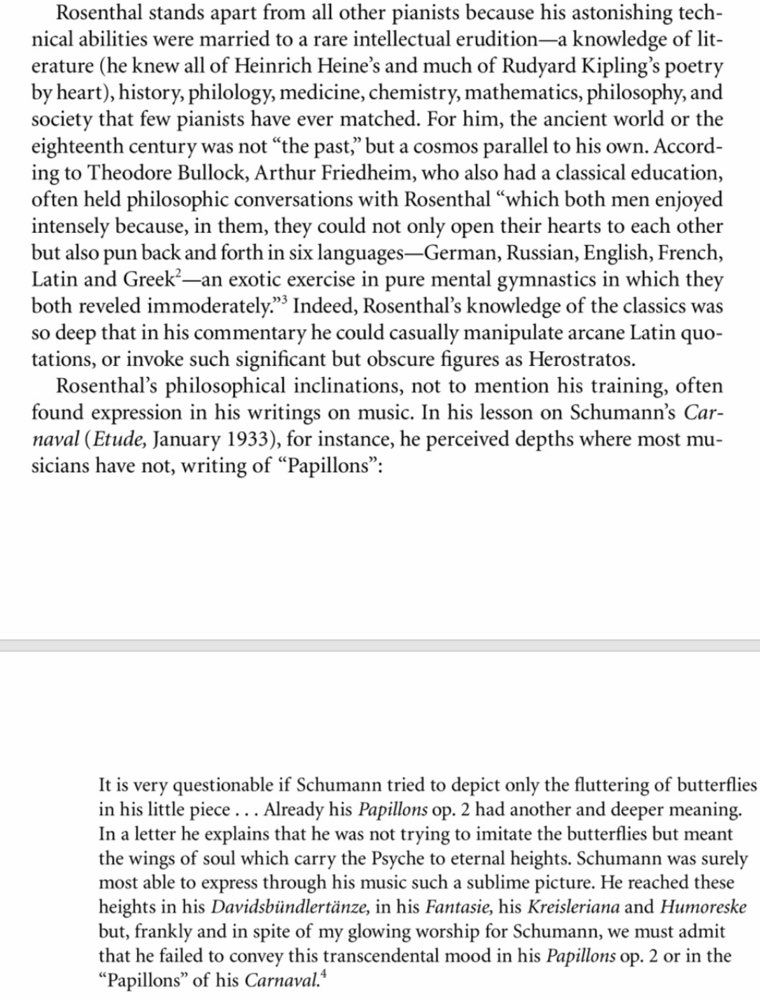
Moriz Rosenthal in Word and Music: A Legacy of the Nineteenth Century
Mark Mitchell, Allan Evans
Indiana University Press, 2005
Rosenthal made his remarks about the lessons in Tivoli in an article written on the occasion of the centennial of Liszt's birth and published in Die Zeit, Berlin.
Where did Rosenthal live in Vienna when Jorge Bolet studied with him? A letter dated 2 June 1924 gives Wien XVIII, Anastasius Grün 38 as his address [Anastasius-Grün-Gasse 38, 1180 Wien (Währing)]. Mattehus Smits tells me that in his files he has another address, which I think may be the correct one: Wohllebengasse 11 Wien.
Letter from composer Moriz Moszkowski to Henri Hinrichsen, dated 13 April, 1902, from Paris:
Would you be so kind as to have the following compositions of mine sent to Mr. Moriz Rosenthal (Wohllebengasse 11, Vienna) and Mr. Josef Lhévinne (Bayreutherstr. 10 [c/o Fr. Silber], Berlin)?
To Rosenthal: Caprice espagnol / Suite Op. 50 / Scherzo-Valse Op. 40 / Frühling/ Etude in D major Op. 48.
To Lhévinne: Suite Op. 50 / Scherzo-Valse from *Boabdil* / La Jongleuse / Bagatelles Op. 63 / Etude in D major Op. 48.
The two gentlemen mentioned have asked me to send them pieces that I consider suitable; and since both have always enjoyed great success in concert with my compositions, it would seem appropriate to fulfil their requests.
Some of Rosenthal's activities during the year 1935 when JB met him - he may actually have met him previously, as MR taught as a faculty member of Curtis in Philadelphia from 1926 to 1928. On 28 February 1928 Moriz Rosenthal gave a recital at Curtis which Jorge probably heard. His programme included Beethoven's Sonata No. 30 Op.109 in E major, Schubert's Wanderer Fantasie, Chopin's Barcarolle, Albeniz's Triana (from the Iberia Suite) and Liszt's Hungarian Rhapsody No. 2.
12 March, 1935: Musikverein, Vienna, Austria
Beethoven, Piano Sonata No.28 in A major, Op.101
Brahms, Variations on a Hungarian Song in D major, Op.21 No.2
Schumann, Novelette in D major, Op.21 No.2, Vogel als Prophet, Op.82 No.7 (from Waldszenen), Traumeswirren, Op.12 No.7 (from Fantasiestücke)
Rosenthal, Variations on an original theme
Chopin, Nocturne in F minor, Op.55 No.1, Ballade No.3 in A-flat major, Op.47, Etude in G-sharp minor, Op.25 No.6, Etude in C minor, Op.25 No.12
Debussy, Reflets dans l’eau (Images, Book I No.1)
Liszt, Tarantella, S.162 No.3 (from Venezia e Napoli)
24 March 24, 1935: BBC’s Studios [?], London, England (Studio Radio Broadcast |)
Chopin: Piano Sonata No.3 in B minor, Op.58 – III [incomplete]
This was part of a 45 minute programme Rosenthal gave for the BBC. The recorded excerpt comes from a private individual who had just acquired a home disc-cutter and recorded two sides of the broadcast to test his equipment.
29, 31 March 1935
Abbey Road Studios (Studio 3), London, England (Studio Recordings )
Chopin: Nocturne in E-flat major, Op.9 No.2
Chopin: Etude in F minor, Op.25 No.2
Chopin: Etude in A-flat major, B.130 No.2 (from Trois Nouvelles Études)
Chopin: Mazurka in A-flat major, Op.50 No.2
Chopin: Etude in G-flat major, Op.10 No.5
21, 23 November 1935
Abbey Road Studios (Studio 3), London, England (Studio Recordings)
Chopin: Waltz in A-flat major, Op.42
Chopin: 24 Preludes, Op.28
o No.6 in B minor
o No.3 in G major
o No.7 in A major
Chopin: Mazurka in A-flat major, Op.50 No.2
Chopin: Mazurka in G major, Op.67 No.1
Chopin: Mazurka in B minor, Op.33 No.4
Rosenthal: New Carnaval de Vienne (on themes by J. Strauss II)
(Source of recordings: Christian Johansson).
In 1976, Jorge spoke about Rosenthal to Morris Risenhoover (for his book Artists as professors):
'You know, there are many, many performers who are what I call "intuitive musicians." They seem to know music and they seem to feel music through an inborn instinct, and they know things and they do things which no one has really taught them. I studied very briefly with Rosenthal.
'Now here was a great pianist, a great artist, a great musical personality. He was a student of Liszt, you know, a man who you would think would have so much to say about any piece of music that any student played for him. (I must say he was terribly expensive. A friend of mine fortunately paid for my lessons at the time because I certainly could never have afforded them.) But I cannot tell you one single thing that this man ever told me. He never told me anything. I would arrive at his villa and say, "What are you going to play for me today?" "Well, the Appassionata." "Oh, good. Fine. Wonderful." So I would sit down and play the Appassionata from beginning to end "Um, that's very good, that's very nice. Now what else are you going to play for me?" These were his lessons. I played for him vast amounts of repertoire: the Liszt Sonata; the Chopin ballades, scherzos, sonatas; Beethoven sonatas. Everything was "fine."
'One thing I do recall him telling me: he pointed out very clearly what a bad composer Liszt was, and this rather amazed me because I should think he would have had Liszt on the highest pedestal. Well, that's the only thing I ever recall him telling me
'Now, you see, I am not that kind of musician. I am not an intuitive musician. I think I have a certain intuition for music, but my intuition is more for the mechanical aspect of piano playing, having always had a very great facility for it. But my facility for appreciating purely musical, aesthetic, and emotional values, I must confess, I have had to receive from other people. I have always been a very analytical student of music and piano playing, and in order to learn those musical values, to appreciate them, absorb them, and be able to project them with conviction in my own playing, I have had to analyze and scrutinize things down to the cell within a cell within a cell, so that whenever I play, I assure you that I have a very exact road map of everything.'


Comments